Healthcare has a reputation for moving slowly, and most of the time it earns it. So it is worth noticing that one of the biggest operational shifts in the business of medicine is happening right now, and it is happening fast.
Roughly 80% of health systems are already exploring, piloting, or running generative AI in their revenue cycle, a jump of nearly 40% in under two years. The technology to answer phones, book appointments, and handle routine patient requests is real, and it works.
Here is the part that never makes it onto the sales deck. Most of these projects fail. MIT's 2025 study found that 95% of enterprise generative AI pilots produced no measurable return.
So the honest question for a practice owner weighing a healthcare AI implementation is not "does AI work." It is "why does it work in the demo and fall apart in my office."
Why most healthcare AI rollouts fail
AI truly succeeds when it seamlessly replicates how your best staff works. Think about what that means day to day.
A tool that books appointments perfectly but mishandles one anxious patient call an hour is not saving you time. It is generating cleanup work, plus a reputation risk, plus a staff member who now trusts the system a little less.
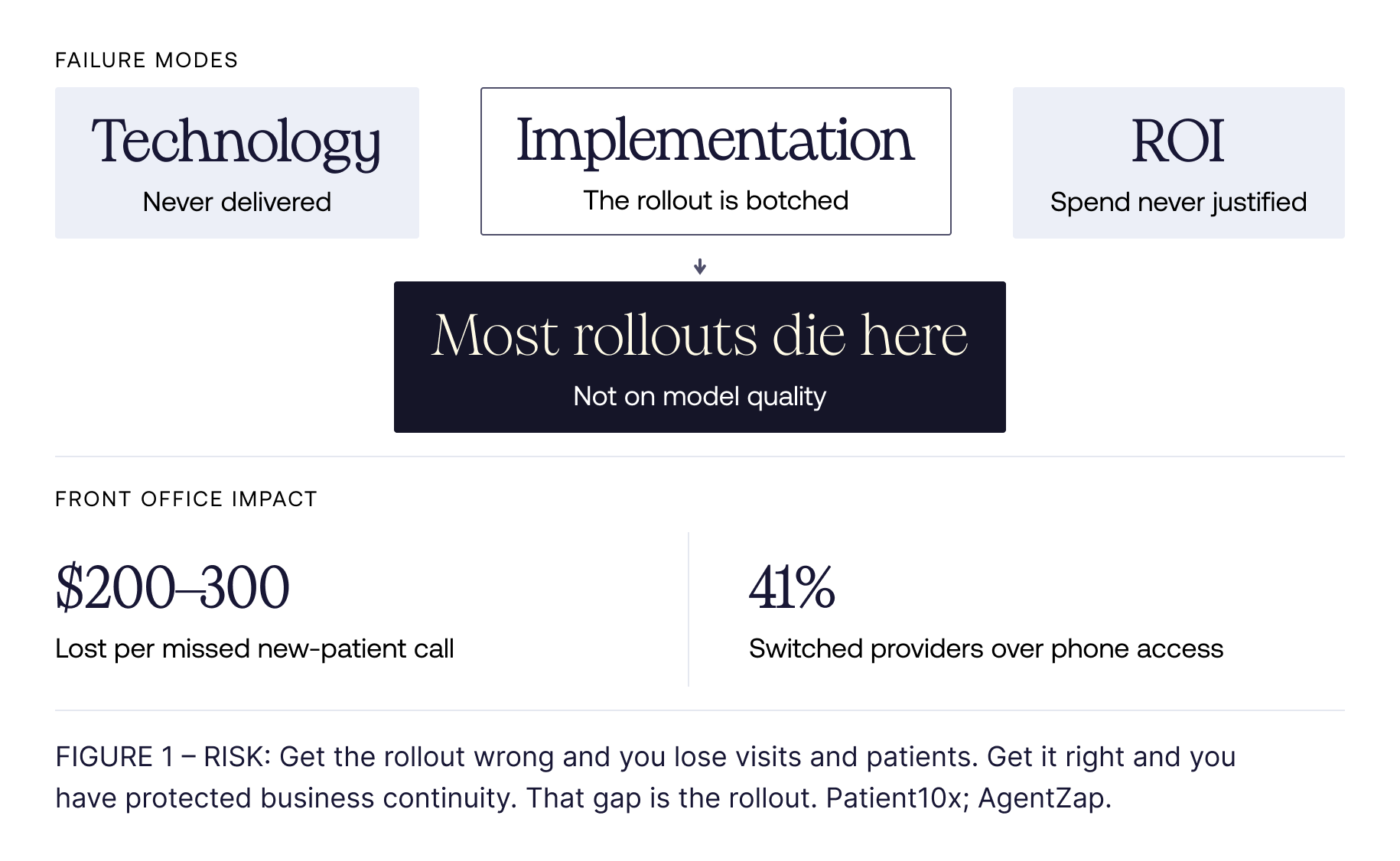
The math on ROI turns negative quietly, one bad call at a time. And here is the thing most vendors gloss over: the model itself is usually not the culprit. The rollout is.
Implementation is where AI rollouts break
The reason a demo shines and a live deployment struggles is that the demo never met your practice. It was not built using input from your staff and custom workflows that your practice has painstakingly developed.
AI makes mistakes, especially early on, but the more common failure is quieter than that. It just won't have the answer. It won't service the patient completely, and patients pick up on that fast. They stop trusting it and ask to speak to a person, usually before AI finishes its task.
The louder failure is the one researchers call hallucination, where the agent answers with total confidence and is simply wrong, which in a front office means the wrong instruction reaching a patient (BMC Health Services Research).

Someone has to teach the system your scheduling rules, your triage logic, your EHR quirks, and the tribal knowledge your front desk carries around in their heads.
The companies that understand this best have all landed on the same answer. Anthropic, OpenAI, and Google are now hiring "forward deployed engineers," people who sit inside the customer's environment and build against real constraints instead of imagined ones.
There is a catch, and if you run an independent practice you have probably already felt it. That hands-on model gets pointed at large health systems with the budgets to pay for it. Everyone else gets self-serve software and a login.
Reducing missed appointments and answering the phone reliably are now top patient-access priorities for practices heading into 2026.
A clumsy AI rollout does not just underperform. It destabilizes the one function that keeps your schedule full. Get it wrong and you lose visits and patients. Get it right and you have protected business continuity. That gap is the rollout.
What actually makes it work: people inside the practice
We don't hand you a login and wish you luck. For every function we take on, we embed a human expert who becomes a member of your team before they are anything else.
For your front office, that's a front office rep answering your phones. For prior authorization, it's a prior auth rep working your auths, submitting and chasing them the way your own staff would. Someone doing the actual job. We call them patient service coordinators, or PSCs.
Our PSC’s are not simply call center workers, they are trained AI experts who can spot a flaw in how AI answers a question or detect a knowledge gap and then work quickly to update the AI model in real time. Therefore, you are not purchasing a model that will soon be obsolete, rather you are investing in a robust AI ecosystem that will continually get smarter and evolve with the needs of your practice.
- Dr. Neville Bamji, CMO, Practicing Gastroenterologist
That's what makes the training investment familiar. You onboard one person, the same way you onboard any new hire. The difference is what happens to that training afterward: everything this one person learns gets encoded into the AI, so you never have to repeat the onboarding to add capacity.
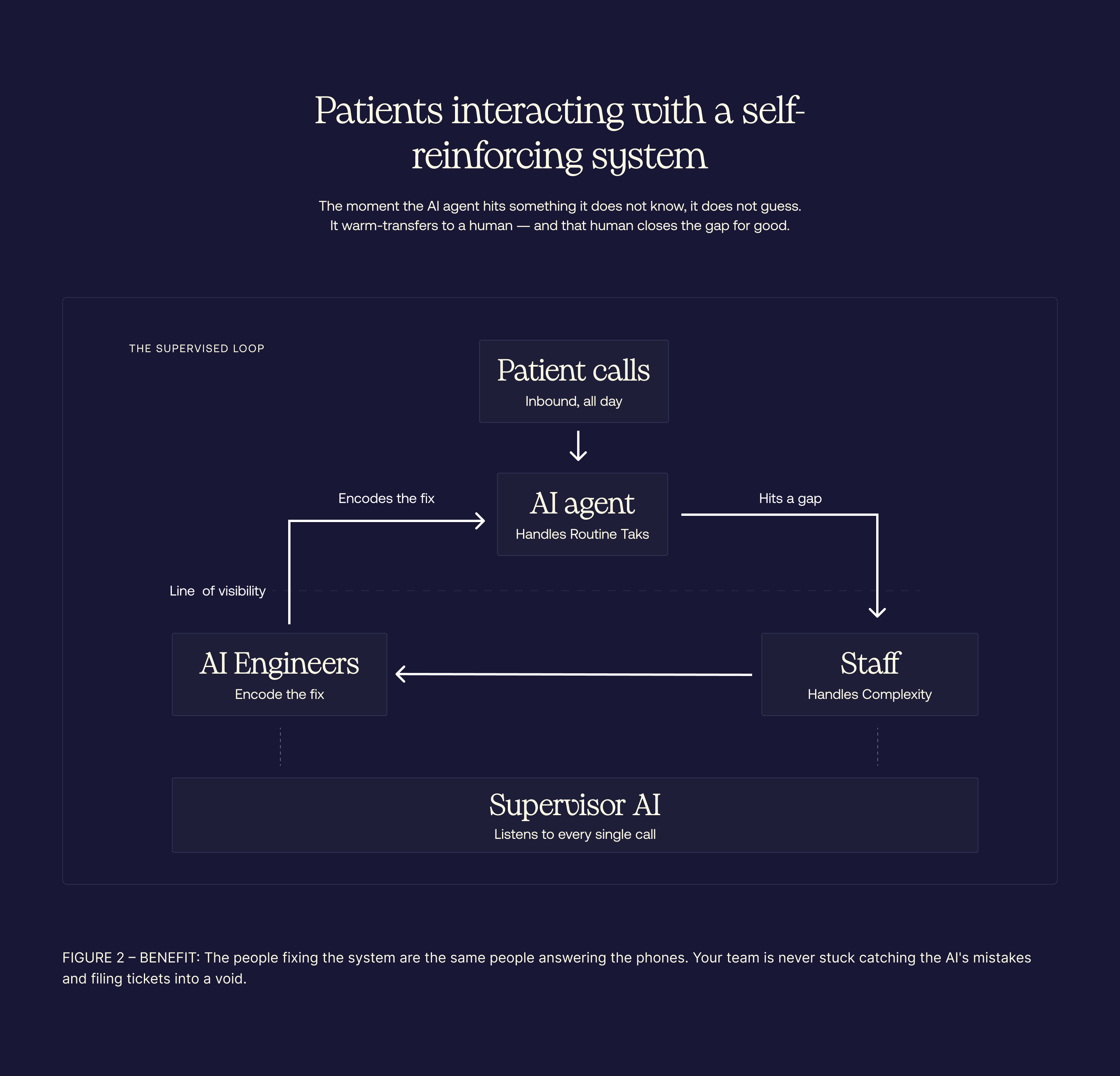
Here is how it works. Our PSCs sit with our engineers and train the AI on your SOPs and the judgment calls your team makes every day. A Supervisor AI then listens to every single call. The moment the AI agent hits something it does not know, it does not guess. It warm-transfers the call to a human.
That human is the PSC, and in that moment they become your first line of defense, rescuing the call before the patient ever senses a problem. Then they carry that gap back to our engineers so the same situation never happens again.
That loop is the whole secret. Your team is not stuck catching the AI's mistakes and filing support tickets into a void. The people building the AI system are the same people answering the phones.
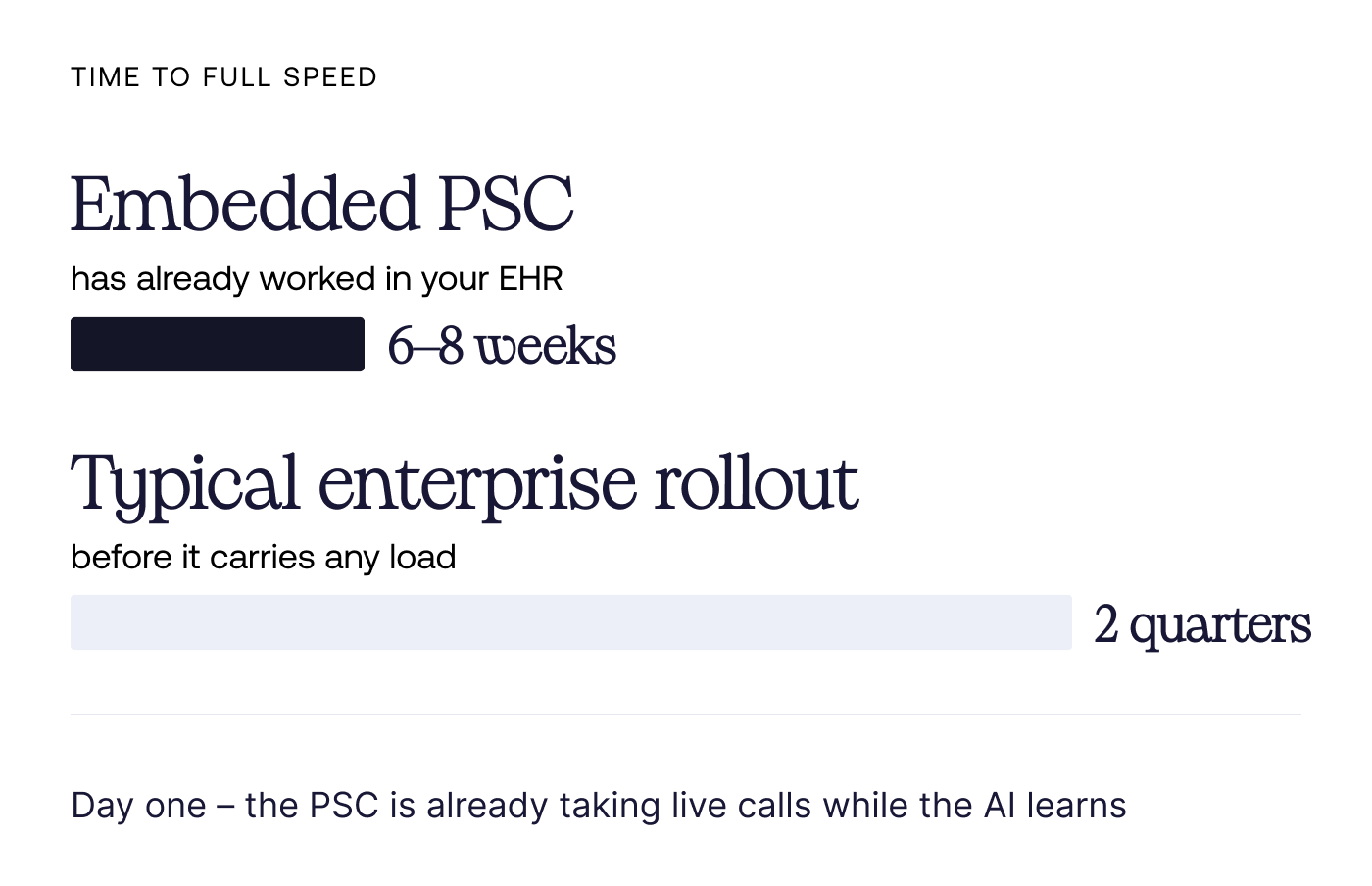
Our PSCs are experts in US healthcare who have worked in your EHR before, so bringing them up to speed takes about 6-8 weeks, not two quarters. And while the AI is still learning, they are taking live calls, which means they add capacity from day one.
There is good evidence this is the right shape, not just a nice story. The research on reducing AI errors in healthcare keeps arriving at the same conclusion: you need technical safeguards and human oversight working together, not one or the other.
According to the American Medical Association, physician trust in AI has roughly doubled as the tools have matured, but that trust rests on the technology being supervised, not turned loose.
Why DIY patient-facing AI almost always fails
Patient-facing AI is not a plug-in. It is a live system talking to real people about their health, using your name and your reputation. Do it yourself and you are betting your front office on software you cannot fully see into or correct in real time.
That is why DIY rollouts almost always fail. Not because the practice did anything wrong, but because no one gave them the layer that catches what the AI doesn't know.
We take the done-for-you approach instead. We own the messy part, the training, the monitoring, the constant correction, so your team can do the thing that actually grows a practice: measuring what the program delivers and deciding where to expand it next.
Healthcare is finally ready for this. The practices that win will not be the ones that bought the smartest model. They will be the ones who rolled it out without breaking anything that was already working.