
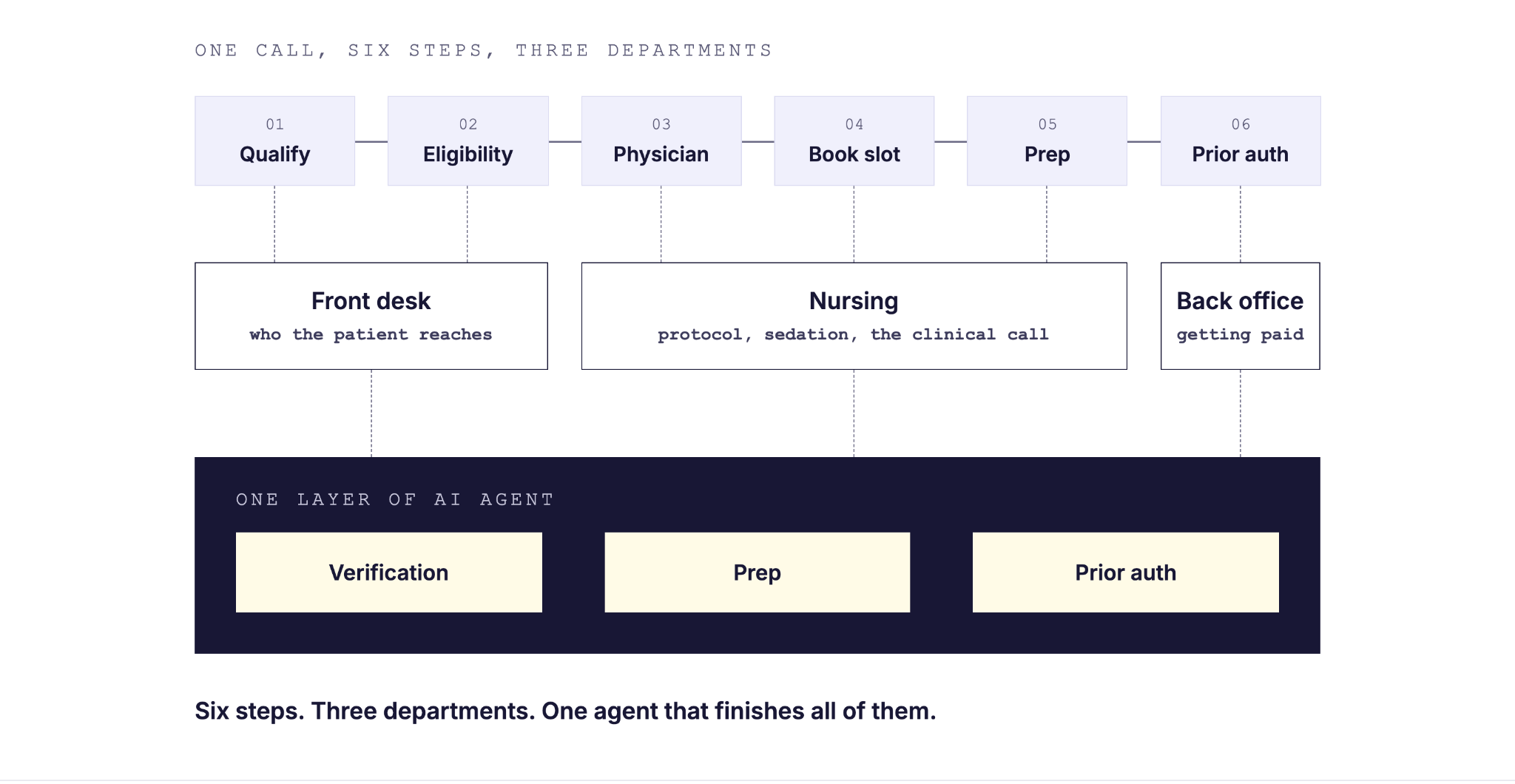
A patient calls to book a colonoscopy. On paper that's one call. In practice it's six decisions stacked on top of each other:
- Qualify based on patient history.
- Check insurance eligibility.
- Find an available in-network physician
- Book the best slot in the right facility.
- Pull physician's protocol and prep instructions.
- Get prior authorization approved.
GI scheduling isn't a calendar problem, it's a rules-heavy orchestration problem. Get one step wrong and the chain breaks.
You can see where it breaks by looking at what lands downstream. Inadequate bowel prep still shows up in about 25% of colonoscopies. A lot of that is step 5: instructions that never matched the assigned protocol, or matched fine but never got explained to a patient who then didn't follow them. One modeled analysis of an outpatient endoscopy suite found an 18% no-show rate, and a booking sitting on an unresolved auth is a no-show with a head start. Neither one ever shows up as a scheduling failure on a dashboard. They show up as an empty room.
Now put a low-resolution AI agent on that call. It books a slot, which is the only part of the chain that looks like scheduling, and stops. No eligibility check. No prior auth flag. No prep instructions tied to the protocol. The call ended without a human, so it counts as "resolved."
Five of the six decisions didn't happen. They land back on your staff anyway, minus the warning that they were coming. That's not automation, it's a slower way to find out your front office still owns the hardest part of the job.
What “resolved” actually has to mean
Most vendors count a call as resolved the moment it ends without a human. We don't. At NextDimension a call is resolved when the patient's need is met and nothing is sitting in a queue for someone else to finish.
The six steps give you a test you can actually run. All six, or it wasn't resolved.
Back to the colonoscopy. A weak agent books the slot and stops. Ours books it, verifies eligibility at the plan level while the patient is still on the line, runs the prior authorization based on patient chart info, and sends the prep instructions that match the assigned protocol.
Which is why the number on a vendor's slide depends entirely on where they draw the line. Book the slot and hang up: resolved. Book it, confirm coverage, clear the auth, and send the right prep: also resolved. Same tick in the same column, five steps of difference underneath.

Why the hard calls are the only ones worth counting
Not all calls are equal, and that's the whole reason the curve bends the way it does.
The easy ones come first. Refill requests, office hours, directions, a simple appointment move. Roughly the first 40% of your volume: three-minute calls that end in one step. A basic agent clears those, and most tools can.
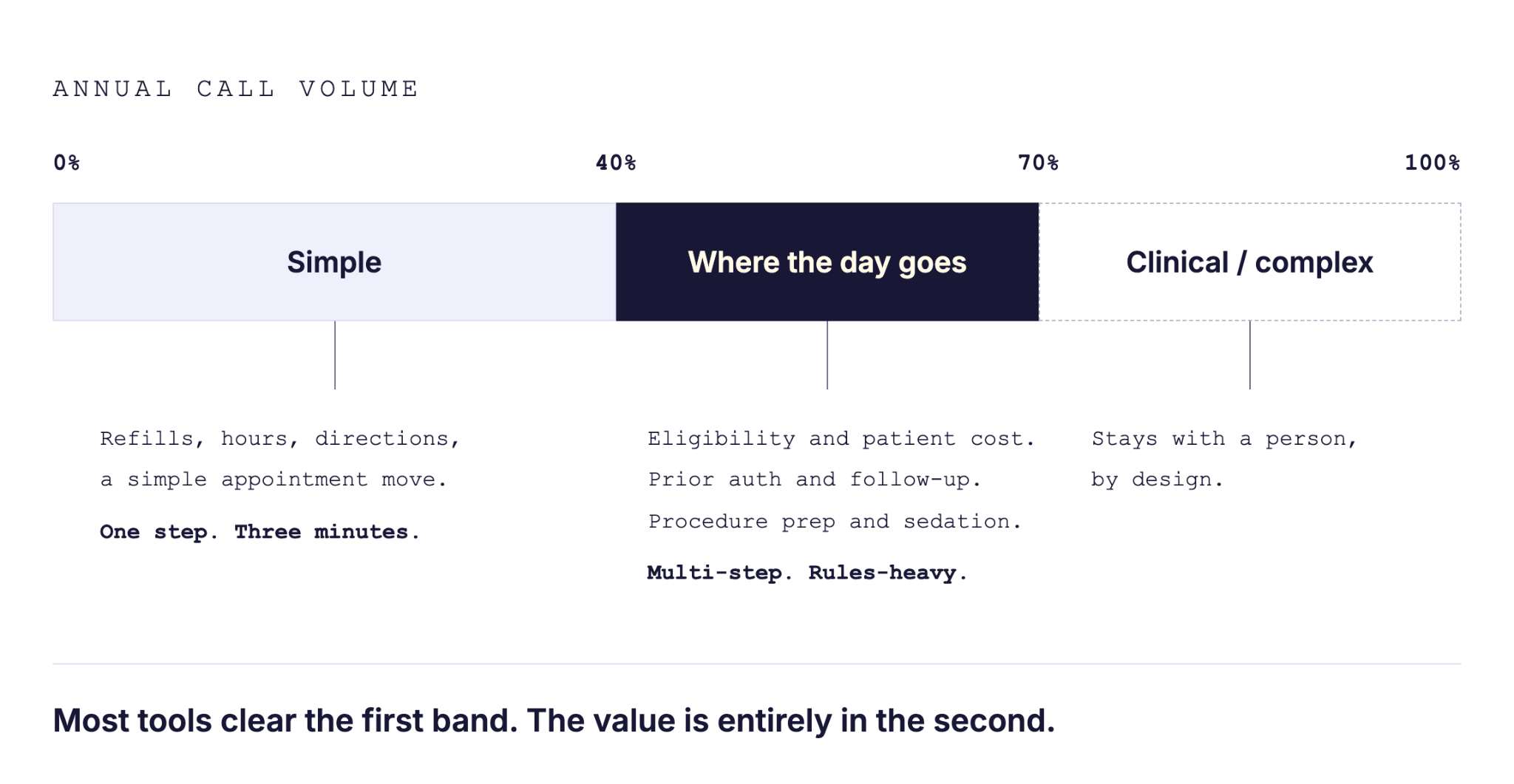
The next tranche is where your staff actually spends the day.
- Insurance eligibility and patient responsibility. The question is rarely "are you in network." It's "what is this going to cost me." Answering that takes a plan-level lookup, deductible and out-of-pocket status, and knowing whether you're in network for that specific plan product rather than just that payer.
- Prior authorization and follow-up. This one is about getting paid. An auth that's missing, expired, or attached to the wrong CPT code becomes a denial after the procedure is done and the cost is already sunk. Somewhere between 35% and 60% of claim denials trace back to eligibility and authorization problems.
- Procedure prep. Instructions have to match the assigned protocol, and then somebody has to confirm the patient understood them. That's a conversation, not a PDF. Patients call back anxious about the prep, about sedation, about whether they can take their morning pills, and plenty of them would rather text than call.
So the top of the curve is worth more than the bottom. The first 40% shaves time off calls that were cheap to begin with. The next 30% takes back the work that actually eats the day.
What multi-step resolution costs to build
None of this is easy, and pretending otherwise is how vendors end up with unhappy customers six months in.
- EHR integration isn't one integration. Each specialty, and often each physician, configures scheduling differently.
- Half your knowledge base lives in SOPs and the other half survives as tribal knowledge with your tenured staff.
- Agents also drift, so holding up the resolution means retraining as payers and providers change the rules.
None of that shows up in a demo. All of it shows up in your resolution rate.
The good news is the effort is front-loaded. Once the agent knows your protocols, your payers, and your prep and sedation logic, the next resolved booking costs almost nothing. A cost that used to climb with volume and spike every time somebody quit turns into a flat one you control.
What a higher resolution rate is worth
Say a mid-size practice runs about 120,000 calls a year with ten front-office staff on the phones. Compare two agents on that volume, one resolving 40% without a human and one resolving 70%. The figures are illustrative, but the direction holds in every model we've run.
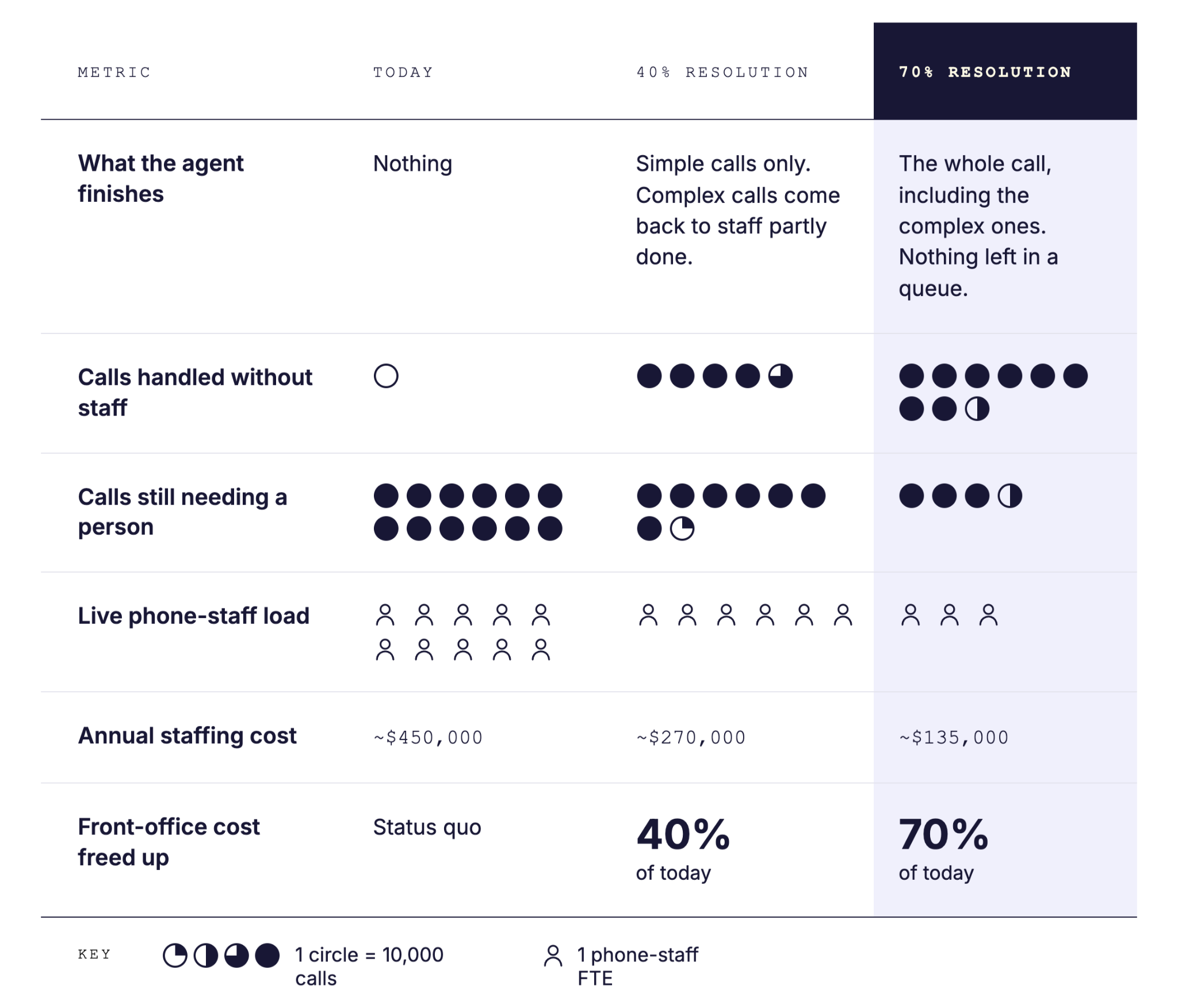
Read the top row before the money rows. A 40% agent leaves steps behind on every call that matters. A 70% agent finishes them. That's the difference the percentages hide.
How much of this turns into freed-up staff depends on your situation: how close you already run to capacity, and whether you put the time back into patient access, more clinicians, or lower prices. Treat the numbers as directional.
The core point holds either way. The AI does the same work at a fraction of the overhead, which changes what a practice can afford to do.
Nobody here is arguing you should cut your team. The argument is that you shouldn't have to depend so heavily on a role that's expensive and hard to keep filled. Front-office jobs were the most-cited turnover hotspot in medical practices in 2025, at $9,000 to $12,000 to replace each departure.
Every routine call the agent absorbs is one less peak you have to over-hire for. And the strain that doesn't get absorbed at the front desk tends to end up on your physicians.
What a half working agent costs you
An agent that resolves 30% to 50% of calls and one that clears 70% aren't different by degree. One removes work. The other creates it.
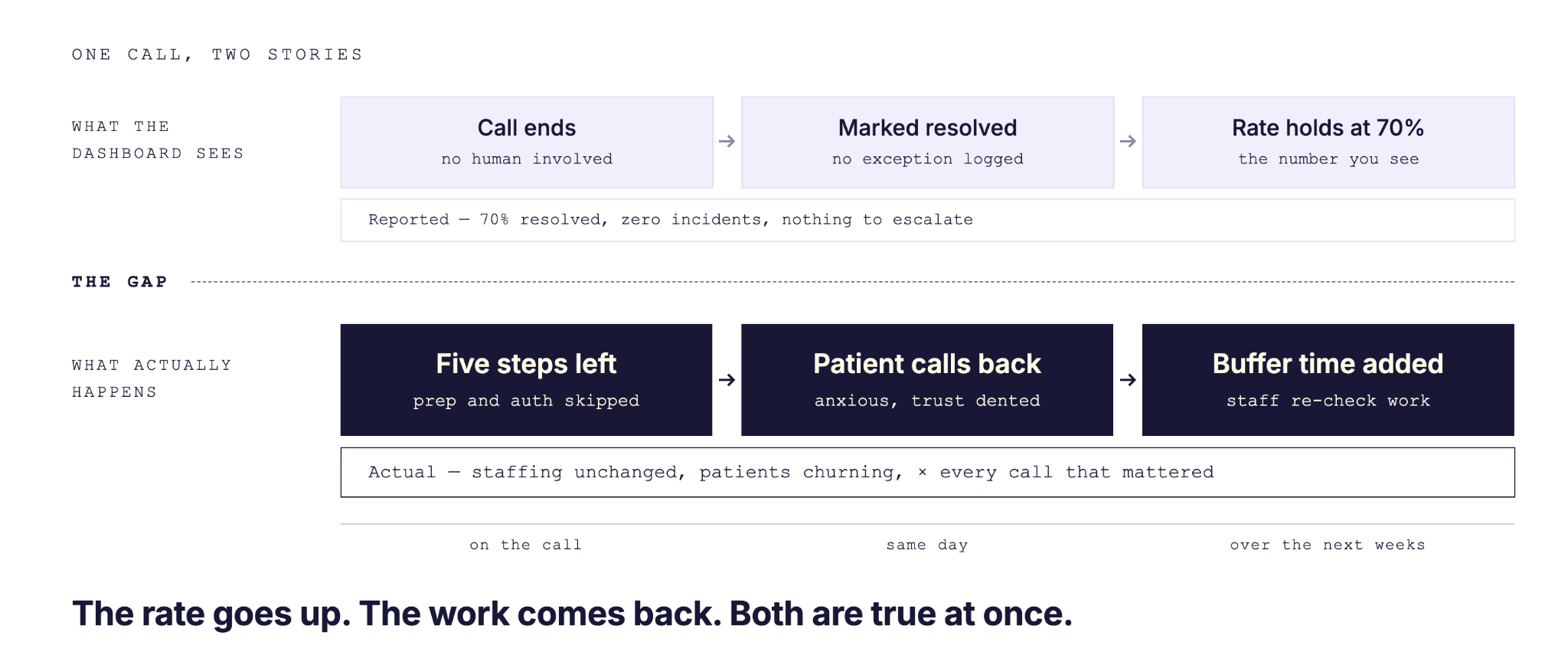
Here's the failure mode nobody demos. The agent won't have every answer, and it won't fully handle every patient.
- Patients stop trusting the virtual assistant and ask for a person, usually before it has finished whatever it was doing.
- Escalations climb while your automation rate still looks flattering, because the call counted as handled right up until the patient asked for a human.
- Your own team catches on and starts building in buffer time to check the agent's work, which spends the efficiency you paid for.
And the patient doesn't blame the vendor. As far as they're concerned, they were talking to you.
Healthcare already runs hot on the phones. 23% of calls go unanswered. A half-working agent doesn't fix any of that. It adds one more way to fail.
Patients don't complain, either. They book somewhere easier next time. With no-shows costing about $200 a visit, friction at the front door gets expensive quickly.
The question to ask your vendor
Resolution rate is a fine place to start and a bad place to stop. The question worth asking isn't "what's your resolution rate." It's "what do you count as resolved, and can I watch it happen?"
Then ask them to walk one procedure scheduling call all the way through. All six decisions, not just the one that looks like scheduling.
That's the standard we hold ourselves to at NextDimension. If you want to see it on your own call types, book a demo and we'll work your hardest calls, not our easiest ones.
Frequently asked questions
What is a good AI call resolution rate in healthcare?
For a mature, year-one deployment, 55% to 70% is realistic, and platforms built to complete whole workflows rather than single steps can push past it. Healthcare benchmarks lower than other industries because its calls carry eligibility, compliance, and patient-safety steps that a simple transaction doesn't. The rate only counts if the vendor defines "resolved" as a completed task rather than a deflected one.
What counts as a resolved call?
A call is resolved when the patient's need is met and nothing is left in a queue for staff to finish. Ending it without a human isn't the same thing. A booking made without verifying coverage, or a "call back later," is deflection.
How does the AI call resolution rate affect ROI?
The cost of a real deployment is front-loaded. Once the AI is integrated and trained on your protocols and payers, each additional resolved call costs almost nothing while removing expensive human work. Moving from 40% to 70% adds little cost but can roughly double annual savings and halve your reliance on live staff for routine calls.
Why are healthcare AI resolution rates lower than other industries?
Healthcare calls are more complex. A single scheduling call can involve insurance eligibility, physician-specific rules, prep protocols, and prior authorization, none of which apply to a retail order-status lookup. A lower rate on genuinely complex calls can represent more real work than a high rate on simple ones.
Sources
- GI scheduling as an orchestration problem: MDfit
- Inadequate bowel prep rate: Digestive Endoscopy
- Outpatient endoscopy no-show modeling: Duke Scholars
- Claim denials from eligibility and authorization: Experian Health, State of Claims 2025
- Front-office turnover and replacement cost: MGMA
- Unanswered and after-hours call volume: AgentZap
- No-show cost per visit and system-wide: Dialog Health